

Obtaining a skilled visa Australia from Vietnam in 2026 is no longer a matter of luck; it's a high-stakes, document-heavy mission that requires a precise, dual-country strategy to succeed. You've likely spent hours worrying about the competitive 85 to 95 point thresholds or wondering how to verify your Vietnamese professional experience for a rigorous skills assessment. It's natural to feel overwhelmed by the shifting regulations for Subclasses 189, 190, and 491, especially when your family's future depends on the absolute precision of your application.
We understand these pressures and are here to replace your uncertainty with a structured plan for success. This definitive guide masters the complexities of the current migration landscape, offering you a tailored strategy built specifically for Vietnamese professionals. You'll gain a clear roadmap to permanent residency, a breakdown of the latest points test requirements, and a preview of how professional representation in both Sydney and Ho Chi Minh City can remove the obstacles standing between you and your Australian dream.
Key Takeaways
- Compare the distinct advantages of the 189, 190, and 491 subclasses to select the pathway that offers you the highest probability of success.
- Master the 2026 points test criteria to ensure your score exceeds the competitive thresholds required for a formal invitation.
- Resolve common hurdles specific to obtaining a skilled visa Australia from Vietnam, such as document translations and the verification of Vietnamese employment history.
- Utilise a dual-country strategy that leverages expert representation in both Sydney and Ho Chi Minh City to streamline your permanent residency application.
- Gain a comprehensive roadmap that transforms the complex migration process into a clear, manageable sequence of professional milestones.
Navigating the Skilled Visa Landscape from Vietnam in 2026
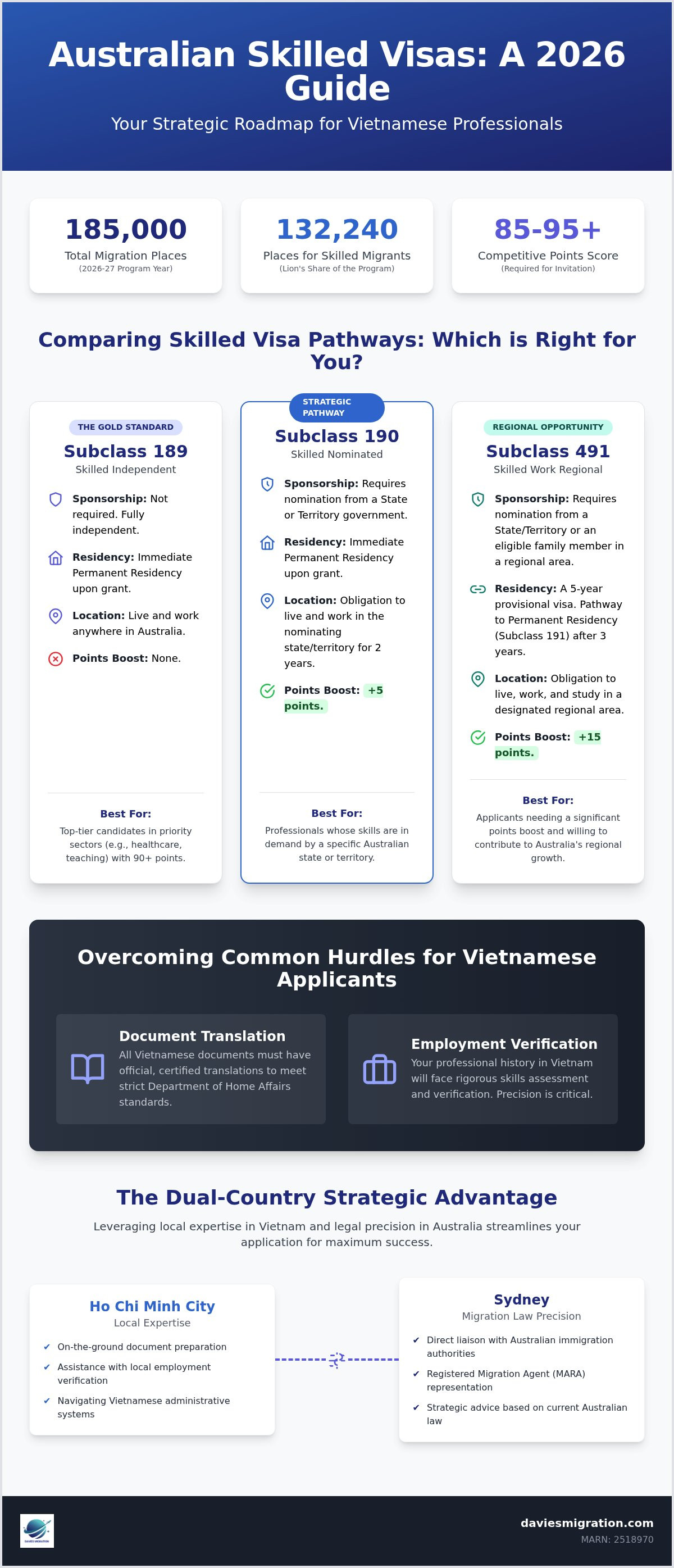
General Skilled Migration (GSM) serves as the most effective route for professionals seeking a skilled visa Australia from Vietnam to secure permanent residency. Unlike employer-sponsored streams, GSM allows you to move based on your own merits, qualifications, and professional background. In 2026, the migration climate is defined by a strategic shift. The Australian government has allocated 132,240 places to the skilled stream for the 2026-27 program year, representing the lion's share of the 185,000 total places available. There's a particular emphasis on regional areas, making pathways like the 491 visa more accessible for those willing to contribute to Australia's growing regional hubs.
Securing your future requires more than just filling out forms; it demands a comprehensive migration strategy. Because invitation rounds are competitive and processing times for subclasses like the 189 or 190 typically range from six to eight months for 75% of applicants, starting your journey early is essential. A well-timed strategy ensures your skills assessment and English results remain valid throughout the entire invitation cycle. This proactive approach prevents the stress of expiring documents and keeps you ready for the next round of invitations, ensuring you don't miss a critical window of opportunity.
Why Australia Remains the Top Choice for Vietnamese Talent
Australia offers a unique blend of economic stability and a workplace culture built on the "fair go" principle. This cultural foundation ensures that your hard work is recognised and rewarded regardless of your background. When you secure a skilled visa Australia from Vietnam, you aren't just moving for a job; you're joining a thriving community. Vibrant hubs in Sydney, particularly around Canley Vale, and various suburbs in Melbourne provide a familiar cultural touchstone for new arrivals, making the transition feel like coming home.
The long-term benefits of permanent residency extend far beyond the workplace. PR status grants you access to world-class healthcare through Medicare and subsidised education for your children, providing a robust safety net for your family's future. Understanding the history of immigration to Australia reveals a long-standing commitment to welcoming skilled individuals who contribute to the nation's growth and cultural diversity, a tradition that continues to offer immense value to Vietnamese professionals today.
The Role of a Registered Migration Agent (MARA)
The complexity of Australian migration law means that professional guidance is often the difference between a visa grant and a refusal. Engaging a Registered Migration Agent, such as Annie Davies (MARN: 2518970), provides a vital layer of security against common scams and misinformation. It transforms a daunting legal process into a managed journey, giving you the confidence that every detail is handled with expert care.
A qualified representative offers more than legal advice; they act as a bridge between two distinct systems. By choosing a partner who understands both the Australian legal framework and the specific context of Vietnamese documentation, you ensure your application is presented with absolute precision. You can explore our full range of migration services at Davies Migration to see how we manage these intricate details, allowing you to focus on your professional transition while we navigate the regulatory hurdles for you.
Comparing Subclasses 189, 190, and 491: Which is Right for You?
Choosing the right pathway for a skilled visa Australia from Vietnam depends largely on your occupation and your current points score. The Australian government uses three primary subclasses to manage the influx of talent, each with its own set of rules and rewards. While the 189 is entirely independent, the 190 and 491 rely on state or regional support. This nomination isn't just a formality; it provides a vital points boost that often determines whether you receive an invitation in the highly competitive 2026 environment.
Subclass 189: The Gold Standard of Independence
The Skilled Independent visa (subclass 189) is frequently called the "Gold Standard" because it offers immediate permanent residency without requiring state sponsorship. However, in 2026, it remains the most difficult to obtain. Invitations are currently focused on "pro-priority" sectors like healthcare and teaching. If your occupation isn't on the Medium and Long-term Strategic Skills List (MLTSSL) with a score of 90 points or higher, this pathway may be out of reach, as the SkillSelect system prioritises those with the highest scores in critical fields.
Subclass 190 and 491: The Power of State Nomination
States like New South Wales and Victoria use the 190 and 491 visas to address specific local labour shortages. The 190 visa provides a 5-point boost and leads to PR, while the 491 visa offers a substantial 15-point boost. This 15-point increase is a game changer for many Vietnamese professionals who find themselves just short of the 85-point mark. In exchange for this support, the 491 requires you to live and work in a regional area for at least three years before applying for permanent residency. Even the 190 visa typically involves a commitment to reside in the nominating state for your first two years. This regional focus is particularly relevant for those pursuing a skilled visa Australia from Vietnam who are open to settling in emerging economic centres like Geelong, Darwin, and Adelaide.
Your professional background dictates which list applies to you. If your role appears on the Short-term Skilled Occupation List (STSOL) rather than the MLTSSL, your options will be limited to the 190 or 491 pathways. Understanding these nuances early allows you to build a stronger case for nomination. If you're unsure which subclass aligns with your career history, you can book a strategy session to map out your specific trajectory.
Maximising Your Points: The Strategy of the Points Test
To secure a skilled visa Australia from Vietnam, you must look beyond the base eligibility threshold of 65 points. In the competitive 2026 selection rounds, successful applicants typically present a score of 85 or higher to receive an invitation. This reality requires a meticulous approach to every point-scoring category. While age and qualifications are largely fixed, factors like partner skills and language proficiency offer significant strategic leverage. If your spouse has a positive skills assessment and competent English, they can contribute up to 10 points to your tally. This extra margin often makes the difference between remaining in the pool and receiving a formal invitation. You can Explore Australian visa options to see how these points apply across the different skilled pathways.
Work experience and education within Australia also provide a significant boost. If you've completed a degree at an Australian institution or have at least one year of local professional experience, you can claim additional points that overseas applicants cannot access. We help you identify these hidden opportunities during your initial assessment, ensuring every possible point is claimed with the correct supporting evidence.
English Language Mastery: PTE vs. IELTS for Vietnamese Applicants
Vietnamese professionals often find that the Pearson Test of English (PTE) Academic yields more consistent results for "Superior English" scores compared to the traditional IELTS format. The computer-based marking of the PTE can be less subjective, making it easier for diligent students to secure the 20 points required for a competitive edge. Achieving this score is frequently the "make or break" factor for a skilled visa Australia from Vietnam. We recommend utilising specialised preparation centres in Ho Chi Minh City that focus on the PTE format. This targeted preparation ensures your first attempt meets the high standards required by the Department of Home Affairs.
The Skills Assessment: Proving Your Worth
Before submitting your Expression of Interest, you must obtain a positive assessment from an authority like the Australian Computer Society (ACS) for IT roles, Engineers Australia, or AHPRA for nursing. This step is particularly complex for Vietnamese graduates because assessing bodies require specific evidence that your degree meets Australian standards. A common pitfall involves "deeming dates," where an authority may deduct several years of your experience to meet their entry requirement. This deduction can leave you with fewer points than you initially calculated. Ensuring your Vietnamese work references are formatted correctly and aligned with Australian ANZSCO standards avoids these costly errors and protects your points tally.
The Vietnamese Perspective: Overcoming Local Hurdles
Applying for a skilled visa Australia from Vietnam presents a unique set of administrative challenges that generic migration guides often overlook. The Australian Department of Home Affairs requires a level of documentary precision that can be difficult to achieve within the Vietnamese regulatory framework. We focus on bridging this gap by ensuring your local professional history is translated into a format that Australian assessors trust and accept. Our dual-country presence is specifically designed to streamline the skilled visa Australia from Vietnam process, providing you with a reliable anchor in both Ho Chi Minh City and Sydney.
To build a successful application, you must provide "Vietnamese-specific" evidence that proves the legitimacy of your work history. Standard reference letters are rarely sufficient on their own. We assist you in gathering a robust portfolio of evidence, including:
- Social Insurance Records (VSS): Comprehensive printouts that align perfectly with your claimed employment periods.
- Personal Income Tax (PIT) Statements: Official records that verify your salary levels and professional seniority.
- Certified True Copies: Documents notarised at the correct government levels to satisfy Australian high-commission standards.
- Bank Statements: Consistent salary credits that mirror your employment contracts and tax filings.
Document Preparation in Ho Chi Minh City and Hanoi
The notarisation process in Vietnam is multi-layered and often confusing for first-time applicants. Our local team manages the verification of your degrees and transcripts at the Department of Foreign Affairs, which ensures your documents are "visa-ready" before they ever reach a case officer's desk. This meticulous preparation removes the risk of "Request for Further Information" (RFI) delays, which can add months to your waiting time. We specialise in translating complex Vietnamese work histories into precise Australian occupational definitions, ensuring your skills assessment reflects your true professional value.
Planning Your Move: From HCMC to Sydney or Melbourne
Migration is an emotional journey as much as a legal one. The transition involves significant life changes, from selling assets in Vietnam to finding your place in Australia's "fair go" culture. We provide a structured timeline for this transition, helping you manage the logistics of moving while we handle the complexities of the law. Having a supportive agent who understands your cultural background reduces the psychological burden of the move, allowing you to focus on your future career in Australia. You can explore our full range of Davies Migration services to understand how we support you from the first consultation to your eventual arrival.
Securing Your Future with Davies Migration
Securing a skilled visa Australia from Vietnam is a complex undertaking that requires more than just a basic understanding of the law; it requires a partner who has walked the path before. Annie Davies (MARN: 2518970) leads our firm with a unique perspective, acting as a dedicated bridge between the Vietnamese professional community and the Australian migration system. By choosing an agent who understands the nuances of both cultures, you gain a representative who can advocate for your skills with absolute precision while navigating the specific challenges of Vietnamese documentation.
Our tiered service approach is designed to provide clarity at every stage of the process. We don't just lodge applications; we build comprehensive migration strategies that account for the 2026 points thresholds and state nomination requirements. This structured method ensures that every document is verified and every point is claimed, significantly reducing the risk of refusal. Our process includes:
- Initial assessments to confirm your realistic points score before you commit.
- Skills assessment management to ensure your Vietnamese experience is recognised by Australian authorities.
- EOI submission and visa lodgement to manage the final, critical steps of your permanent residency journey.
The support we offer extends well beyond the visa grant. With physical offices in both Ho Chi Minh City and the Sydney suburb of Canley Vale, we provide a continuous link of support from your home country to your new one. Canley Vale is a central hub for the Vietnamese-Australian community, and our presence there means you have access to professional guidance and a familiar network as soon as you arrive. This post-arrival support helps you settle quickly, allowing you to enjoy the benefits of your new life without the stress of navigating a foreign system alone.
The Davies Migration Advantage: Why We Are Different
We operate on a model of precision and empathy, recognising that every application represents a person's dream. We offer a free initial assessment to determine your realistic chances of success for a skilled visa Australia from Vietnam, providing you with an honest appraisal before you make a financial commitment. This transparency is a cornerstone of our practice, ensuring you have the facts needed to make an informed decision about your future. You can verify our credentials and learn more about our commitment to excellence by visiting the registered MARA agent profile for Annie Davies.
Book Your Consultation Today
The first step toward your Australian residency is a single, purposeful conversation. Your journey begins by gathering your current qualifications and professional records, which we then use to calculate your competitive points score for the 2026-27 program year. Once you have your preliminary documents ready, the next stage is to connect with our team to map out your specific trajectory and remove the obstacles standing in your way.
Your Australian dream is closer than you think.
Your Australian Journey Starts with a Proven Strategy
Success in the 2026 migration landscape depends on your ability to transform a complex set of regulations into a precise, actionable plan. By selecting the subclass that aligns with your professional goals and meticulously calculating your points score, you move from a state of uncertainty to one of organised progress. We manage the intricate details of your skilled visa Australia from Vietnam application so you can focus on the aspirational goal of building a new life. Every document we verify and every point we claim serves as a bridge toward your permanent residency.
Annie Davies (MARN: 2518970) and our dedicated teams in Sydney and Ho Chi Minh City provide the authoritative expert guidance required for this transition. We specialise in the 189, 190, and 491 subclasses, offering a high-standard service that redefines expectations in the migration field. Our dual-office presence ensures that your Vietnamese professional history is translated into an Australian success story with absolute clarity and precision.
Your future in Australia is a shared mission, and we are ready to help you take that first decisive step with confidence.
Frequently Asked Questions
Can I apply for a skilled visa from Vietnam without a job offer?
Yes, you can apply for a skilled visa Australia from Vietnam without a job offer if you qualify for the General Skilled Migration (GSM) stream. Subclasses 189, 190, and 491 are points-based visas that prioritise your skills, age, and English proficiency rather than a specific employment contract. This allows you to secure permanent residency independently and enter the Australian labour market with the flexibility to choose your employer.
What is the minimum IELTS or PTE score needed for an Australian skilled visa?
The absolute minimum requirement is "Competent English," which equates to a score of 6 in each IELTS band or 50 in each PTE Academic component. While this score makes you eligible to apply, it awards zero points toward your total. To remain competitive in 2026, most successful applicants aim for "Superior English," which requires an IELTS 8 or PTE 79 in all bands to claim the maximum 20 points.
How much does a skilled visa for Australia cost for a Vietnamese applicant in 2026?
As of July 2026, the primary applicant charge for a Subclass 189 or 190 visa is between A$6,135 and A$6,140. For those applying for the Subclass 491 regional visa, the base application charge starts from A$6,140. These figures only cover the government's visa application charges; you must also budget for external costs like skills assessments, medical exams, and professional translations of your Vietnamese documents.
How long is the processing time for a subclass 190 visa from Vietnam?
The processing of a Subclass 190 visa occurs in two stages. First, the state nomination phase generally takes between 4 and 16 weeks depending on the nominating state's current backlog. After you receive a nomination and lodge your visa, federal processing by the Department of Home Affairs typically takes 4 to 8 months for 75% of applications, provided all your documentation is complete and accurate.
Can I include my family in my skilled visa application?
You can certainly include your spouse or de facto partner and dependent children in your application. Including your family ensures that everyone receives the same visa status and rights simultaneously, allowing you to settle in Australia together. Your partner may also be able to contribute "Partner Points" to your application if they meet specific English and skills assessment criteria, which strengthens your overall score.
What happens if my skills assessment is rejected?
If your assessment is unsuccessful, the first step is to review the specific feedback provided by the assessing authority to understand the deficiency. You may have the option to appeal the decision, apply for a review, or resubmit a new application with more robust evidence of your Vietnamese work history. We often help clients identify missing technical details in their original submissions to rectify these issues and secure a positive outcome.
Is there an age limit for skilled migration to Australia?
You must be under the age of 45 at the time you receive your invitation to apply for a skilled visa. The points test is designed to favour younger applicants, with the maximum 30 points awarded to those between 25 and 32 years old. Once you reach 45, you are no longer eligible for the 189, 190, or 491 subclasses, so it is vital to begin your strategy well before this deadline.
How do I prove my work experience if my Vietnamese company has closed down?
If your former employer is no longer trading, you can still validate your experience through secondary evidence. Your skilled visa Australia from Vietnam application can be supported by Social Insurance (VSS) records, personal income tax statements, and statutory declarations from former colleagues or managers. This combination of official financial records and professional testimonials provides the necessary proof of your seniority and job responsibilities to the assessing authorities.
Disclaimer
This article provides general information only and is not immigration advice for your specific circumstances. Fees and processing times change; always confirm current figures with the Department of Home Affairs before lodging.
