
The Subclass 485 visa is far more than a simple work permit; it's the most critical strategic window you have to secure Australian Permanent Residency. While many see it as a temporary stay, successful migrants treat this period as a high-stakes foundation for building the points required for skilled migration. You've likely felt the weight of recent policy shifts affecting the subclass 485 graduate visa, from the strict 35-year age limit to the increased A$5,750 application fee introduced in July 2026. It's natural to worry about the narrow six-month application window or which stream aligns with your specific qualification.
We're here to replace that uncertainty with a precise, professional plan that protects your future. This guide will show you how to navigate the latest requirements and strategically use your work rights to transition toward a 189, 190, or 491 visa. We'll explore the nuances of the Post-Higher and Post-Vocational streams, ensuring your documentation is perfect and your roadmap to permanent residency is clear. By understanding the small details now, you can confidently manage the big picture of your life in Australia.
Key Takeaways
- Understand how the subclass 485 graduate visa acts as a high-stakes strategic window to build the necessary points for Australian Permanent Residency.
- Identify whether the Post-Vocational or Post-Higher Education stream matches your specific qualification to ensure you access the maximum stay duration.
- Master the strict eligibility criteria, including the critical six-month application deadline and the updated 2026 English language benchmarks.
- Learn how to align your post-study work experience with the Medium and Long-term Strategic Skills List to strengthen your future skilled visa application.
- Protect your migration journey by recognising common documentation pitfalls that can lead to visa refusals and potential exclusion periods.
Understanding the Subclass 485 Graduate Visa: More Than Just a Work Permit
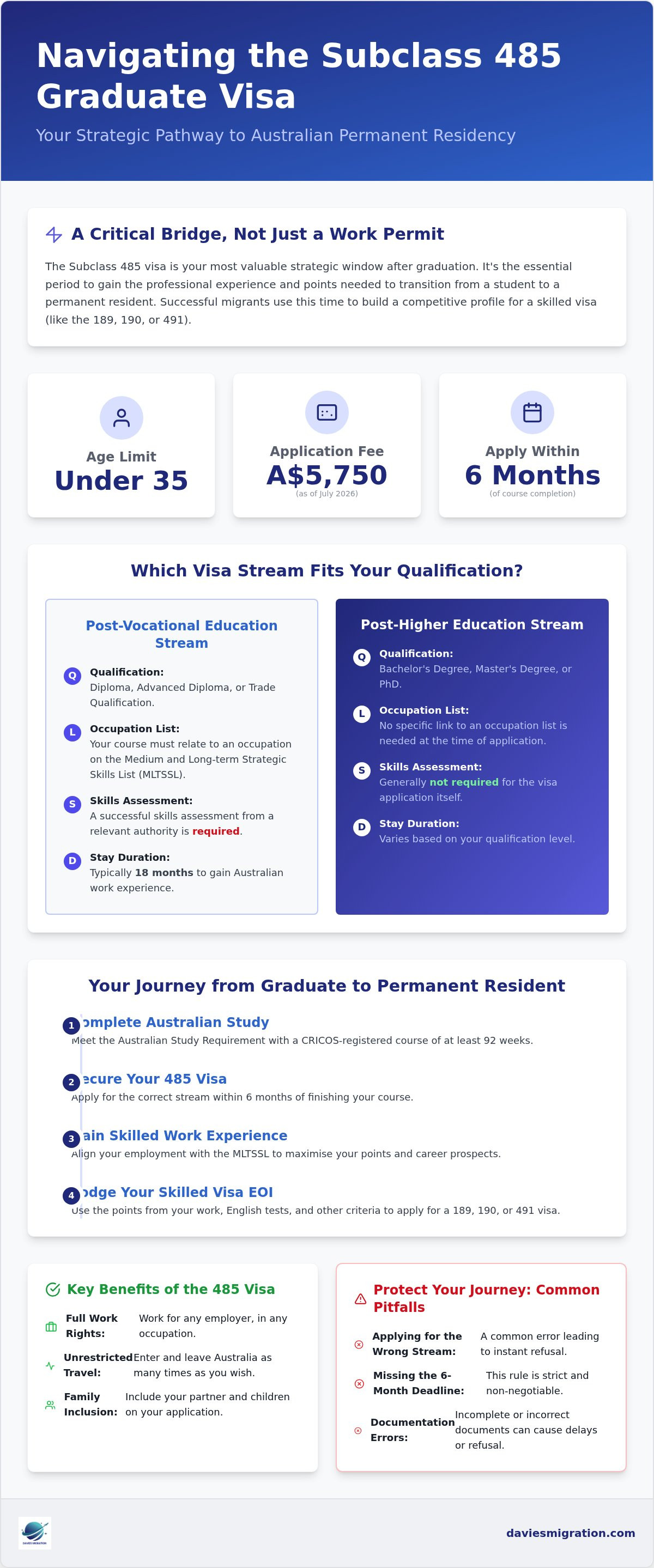
The subclass 485 graduate visa isn't just a document that lets you stay in the country after your graduation ceremony; it's a highly strategic bridge designed for international students who have met the Australian Study Requirement. In the current 2026 climate, where Australia's visa policies have become increasingly focused on high-skilled migrants, this visa serves two vital roles. It allows you to gain the local professional experience that employers in Sydney, Melbourne, and Brisbane demand, while simultaneously providing the time needed to build a competitive profile for permanent residency.
We've seen significant changes as of July 2026, including an application fee increase to A$5,750 and a strict age limit of 35 for most streams. These tighter regulations mean you can't afford a "wait and see" approach. Successful applicants treat the 485 as a foundation, not a finish line. To qualify, you must have completed a CRICOS-registered course of at least 92 weeks, usually within the last six months. This requirement is the non-negotiable cornerstone of your eligibility and requires meticulous planning long before your final exams.
Why the 485 is Critical for Your Migration Strategy
The time granted on this visa is your most valuable asset. It provides the breathing room to complete a Professional Year or secure a role in skilled employment that matches the Medium and Long-term Strategic Skills List (MLTSSL). Every month of professional work in Australia adds vital points to your Expression of Interest (EOI) for 189, 190, or 491 visas. Without this period, many graduates find themselves short of the points required to compete in high-standard invitation rounds. It's the essential bridge between being a student and becoming a permanent resident, offering a clear path to professional migration services and long-term stability.
Key Benefits of the Graduate Visa in 2026
Despite the increased scrutiny from the Department of Home Affairs, the 485 remains one of the most flexible visas in the Australian system. You enjoy full work rights, meaning you aren't tied to a single sponsor and can pivot between employers to find the best fit for your career. It also offers unrestricted travel rights. This is particularly beneficial for our clients who maintain strong ties with home, such as those moving frequently between Australia and Vietnam. Finally, the visa supports family inclusion. You can include your partner and children as secondary applicants, ensuring your entire family stays together as you build your professional life in Australia's vibrant cities.
Comparing the 485 Visa Streams: Which Pathway Fits Your Qualification?
Choosing the correct stream for your subclass 485 graduate visa is not a matter of personal preference; it's strictly determined by the level of the qualification you've just completed. Applying for the wrong stream is a frequent pitfall that can lead to an immediate refusal. The Department of Home Affairs is precise about which CRICOS-registered courses align with specific pathways. For the most accurate and up-to-date details, you should always consult the official Subclass 485 visa information to verify your course's eligibility.
Post-Vocational Education Work Stream
This stream is designed for graduates who have earned a diploma, advanced diploma, or a trade qualification. To be eligible in 2026, your course must be closely related to an occupation currently listed on the Medium and Long-term Strategic Skills List (MLTSSL). Unlike higher education graduates, you'll need a successful skills assessment from the relevant authority, such as Trades Recognition Australia. The stay duration for this stream is currently 18 months. This period is a vital window for tradespeople to gain the Australian experience necessary for future employer-sponsored or skilled migration visas.
Post-Higher Education Work Stream
If you've graduated with a Bachelor's degree or higher, this is your pathway. One of the greatest advantages of this stream is that you don't need a skills assessment or a specific link to an occupation list at the application stage. The stay duration depends entirely on your highest qualification level:
- Bachelor degree: 2 years
- Master degree (coursework or extended): 2 years
- Master degree (research): 3 years
- Doctoral degree (PhD): 3 years
These durations remain the standard for 2026, maintaining a clear reward for research-based qualifications. Graduates who lived and studied in regional areas may also be eligible for a Second Post-Higher Education Work stream visa. This extension offers an additional one to two years of stay, provided you continue to reside and work outside of major metropolitan centres like Sydney or Melbourne. Given the complexity of matching your degree to the right stay duration, you might find it helpful to book a strategic visa assessment to ensure you're applying for the stream that maximises your time in Australia.
Navigating 485 Eligibility Hurdles: Avoiding the Mistakes That Derail Careers
The application process for the subclass 485 graduate visa is notoriously unforgiving, where a single administrative oversight can end an Australian career before it truly begins. Unlike Student visas, the 485 has a strict "one-time only" rule; you generally can't hold this visa twice in your lifetime. This makes your first application a high-stakes moment that requires absolute precision. Beyond the forms, you must maintain adequate health insurance, known as Overseas Visitor Health Cover (OVHC), from the moment you lodge your application. This insurance isn't just a recommendation. It's a legal requirement that must be in place to ensure your bridging visa remains valid while your case is processed.
English Proficiency: The 2026 Standard
Meeting the English language requirement is a hurdle that trips up many talented graduates. As of 2026, the standard for the subclass 485 graduate visa is an IELTS score of 6.5 overall, with no individual band lower than 5.5. If you prefer the PTE Academic, you'll need an equivalent overall score of 57, with minimums of 48 in each communicative skill. A critical change to remember is that your test results must be no more than 12 months old at the time you apply. Many applicants mistakenly rely on older tests used for their initial Student visa, only to face a refusal. We recommend booking your test at least three months before your course ends to avoid missing the strict six-month window.
The "Completion Date" vs. "Graduation Date" Confusion
The most dangerous misconception in migration law is the difference between your completion date and your graduation ceremony. Your six-month application window begins the day your university or college issues a letter confirming you've met all academic requirements. This is your "Completion Date." Waiting for your formal graduation ceremony, which often occurs months later, can push you past the legal deadline. You can find more specific details on these timelines in the Temporary Graduate visa (subclass 485) information provided by the Department of Home Affairs. To stay safe, request your official Completion Letter immediately after your final results are released. This proactive step ensures you have the correct evidence to secure your future without unnecessary stress.
Mapping Your Journey from Graduate Visa to Permanent Residency
The subclass 485 graduate visa is your most powerful tool for transitioning from a student to a permanent resident. While it offers immediate work rights, its true purpose is to give you the time needed to build a competitive profile for General Skilled Migration (GSM). You should view this period as a high-stakes points-building phase. During your stay, you'll aim to qualify for the Skilled Independent (subclass 189), Skilled Nominated (subclass 190), or Skilled Work Regional (subclass 491) visas. Success depends on finding "Skilled Employment" that matches your occupation on the relevant skills list.
Strategic location choices can significantly impact your success. Moving to regional hubs like Geelong, Darwin, or Adelaide isn't just about a change of scenery. It's a calculated move to secure an additional 15 points through regional state nomination. These areas often have lower points thresholds compared to Sydney or Melbourne. This provides a more accessible route to residency for many graduates who are willing to look beyond the major capital cities.
Preparing for the Skills Assessment
A formal Skills Assessment is the absolute foundation of your PR journey. Most assessing bodies require you to prove you have the practical skills to work in your nominated occupation. For many professions, this involves completing at least one year of post-qualification work experience in Australia. Your 485 visa provides the legal right to gain this experience. You must treat this requirement as non-negotiable. Starting the assessment process early ensures you don't run out of visa time before your results are finalised, which protects you from having to leave the country unexpectedly.
The Points Test: Building a Competitive Profile
The Australian migration system rewards those who go beyond the basics. Your time on the subclass 485 graduate visa allows you to stack points in multiple categories. You can earn five points for a year of local work experience and five points for a Professional Year program. Many of our clients also use this time to sit the NAATI CCL test. This adds another five points for community language skills. These small additions often make the difference between receiving an invitation or remaining in the pool. You can calculate your score with our Points Test guide to see how close you are to your goal.
How Professional Migration Support Secures Your Australian Future
The stakes of a visa refusal are exceptionally high. Applying for the subclass 485 graduate visa without professional oversight is a risk that can lead to devastating consequences, including the loss of your "bridging visa" safety net and potential exclusion periods. Unlike education agents who may offer basic advice, a Registered Migration Agent provides the legal expertise required to navigate the Department of Home Affairs' increasingly complex criteria. We don't just see a visa application as a transaction; we see it as the first move in a long-term strategy to secure your life in Australia.
Led by Annie Davies (MARN: 2518970), our team specialises in bridging the gap between temporary study and permanent residency. Our dual-country presence is a cornerstone of our service, offering seamless support for Vietnamese students whether they're currently in Sydney or back home in Ho Chi Minh City or Hanoi. We understand the specific challenges faced by the Vietnamese community, from document translation nuances to the strategic selection of regional pathways that offer the best chance of success.
The Davies Migration Difference
Our "Strategy First" approach is what sets us apart from high-volume agencies. We look five years into your future, not just five months. When we manage your subclass 485 graduate visa, we simultaneously map out your transition to a 190 or 186 visa. This includes expert document auditing to ensure your file is "decision-ready" the moment it reaches a case officer. By meticulous managing the small details now, we prevent the delays and requests for further information that often derail unassisted applications. Learn about our Registered MARA Agent services and how we maintain our high standards of excellence.
Your Next Step: Book a Consultation
Moving from a state of uncertainty to a clear, professional plan is the most important step you can take today. Our online booking system makes it easy for graduates across Australia and Vietnam to connect with Annie Davies and start their journey with confidence. We provide the calm, expert control you need to alleviate the stress of the migration process. Don't leave your future to chance when you can have a visionary partner managing your transition with precision.
Secure Your Australian Future with a Strategic Roadmap
Your journey from international student to permanent resident depends on the strategic decisions you make during your post-study stay. We've explored how the subclass 485 graduate visa serves as the vital foundation for your General Skilled Migration goals, provided you manage the strict timing and documentation requirements with precision. By aligning your work experience with the right skilled occupation list, you can transform these temporary work rights into a clear pathway toward a 189, 190, or 491 visa.
Davies Migration offers the expert control and empathetic guidance you need to navigate this transition. Led by Registered MARA Agent Annie Davies (MARN: 2518970), our team specialises in crafting long-term migration strategies that look far beyond the initial grant. With dedicated offices in Sydney and Vietnam, we provide seamless support to ensure your application is decision-ready and your future is secure.
We're ready to help you move from uncertainty to a place of organised progress. Let's work together to turn your Australian dreams into a permanent reality.
Frequently Asked Questions
Can I apply for a 485 visa if I have already held one before?
No, you generally cannot hold a 485 visa more than once in your lifetime. This "one-time only" rule is a fundamental pillar of Australia's migration system designed to encourage graduates to transition to permanent pathways. The only exception applies to graduates who lived and studied in regional areas, who may be eligible for a second visa under the Post-Higher Education Work stream to extend their stay in a regional centre.
How much does the Subclass 485 visa cost in 2026?
As of July 2026, the application fee for the primary applicant of the Post-Higher and Post-Vocational streams is A$5,750. You should also budget for additional applicants, with fees set at A$2,875 for family members aged 18 or over and A$1,450 for those under 18. These costs represent a significant investment in your future, which is why we prioritise a decision-ready application to protect your capital.
Can I include my partner on my 485 visa application?
Yes, you can include your partner and dependent children as secondary applicants on your subclass 485 graduate visa. They will enjoy the same full work and study rights as you for the duration of the visa period. It is vital to provide comprehensive evidence of your relationship, such as a marriage certificate or proof of a genuine de facto partnership, at the time of your lodgement.
What happens if my 485 visa is refused while I am in Australia?
A refusal while you are onshore can be catastrophic because it often triggers a Section 48 bar, which prevents you from applying for most other visas while remaining in Australia. You would typically have a limited window to appeal the decision at the Administrative Review Tribunal or depart the country. This risk underscores why professional document auditing is essential to ensure your application meets every legislative requirement from day one.
How long is the processing time for a Graduate Visa in 2026?
Processing times vary by stream, but the Post-Higher Education Work stream is currently efficient, with 90% of applications decided within 52 days. The Post-Vocational Education Work stream takes longer, with 90% of cases finalised within four months. These timelines can fluctuate based on the volume of applications and the precision of the documentation provided to the Department of Home Affairs.
Do I need a skills assessment for the Post-Higher Education Work stream?
No, a formal skills assessment is not required for the initial application of the Post-Higher Education Work stream. This is a major advantage for Bachelor, Master, and Doctoral graduates as it simplifies the transition from a Student visa. However, you will almost certainly need a skills assessment later if you intend to transition from your subclass 485 graduate visa to a permanent skilled migration pathway like the 189 or 190.
Can I travel back to Vietnam while my 485 visa is being processed?
Yes, you can travel, but you must first apply for and be granted a Bridging Visa B (BVB) to ensure you have re-entry rights to Australia. While your 485 is processing, you are usually on a Bridging Visa A, which expires the moment you leave the country. We frequently assist students with these travel arrangements so they can visit family in Vietnam without jeopardising their migration status.
Disclaimer
This article provides general information only and is not immigration advice for your specific circumstances. Fees and processing times change; always confirm current figures with the Department of Home Affairs before lodging.
